
QUELIMMUNE
(Selective Cytopheretic Device - Pediatrics (SCD-PED)

What is QUELIMMUNE?
- QUELIMMUNE, also known as the Selective Cytopheretic Device for Pediatrics (SCD-PED), is a humanitarian medical device to treat pediatric patients with acute kidney injury (AKI) due to sepsis or a septic condition. The device is connected in-line to an existing hemodialysis delivery system’s extracorporeal continuous renal replacement therapy (CRRT) circuit.
- QUELIMMUNE was granted approval under a Humanitarian Device Exemption (HDE) by FDA in February 2024 with clinical data establishing safety and probable benefit for this use.
QUELIMMUNE Can Be Efficiently Added to Existing Workflows
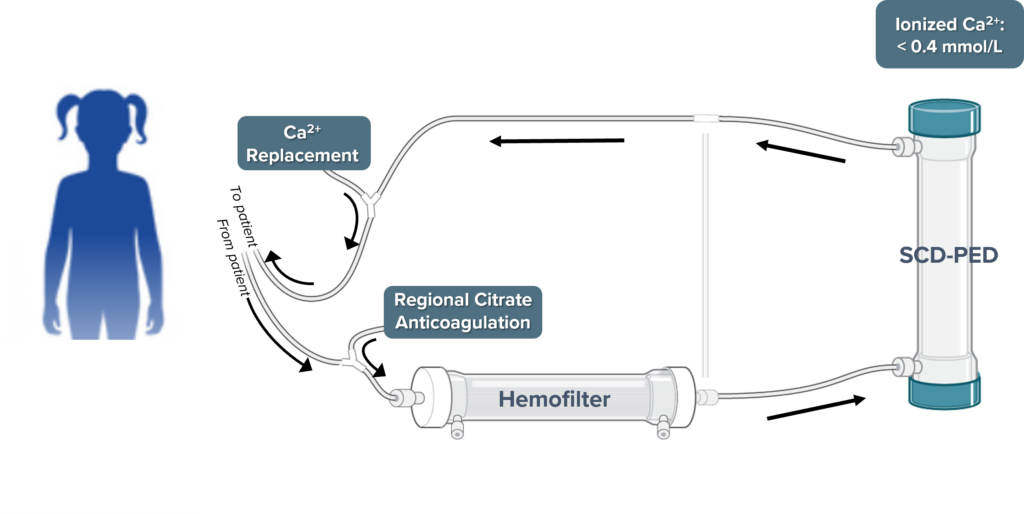
Interested in bringing QUELIMMUNE to your hospital?

Eligibility Checklist (to purchase QUELIMMUNE at your hospital):
- Use Prismaflex or PrisMax CRRT machines
- Currently use or agree to use regional citrate anticoagulation (RCA) in the CRRT circuit
- Commitment to participate in the SAVE Surveillance Registry
- IRB approval of SAVE Surveillance Registry
- Institutional resources to complete data collection
Interested in taking the next step? For more information...
Email us at: quelimmune@seastarmed.com

There are very few therapeutic options available to treat pediatric AKI…these positive [study] results suggest a favorable benefit to risk ratio in the critically ill pediatric population.
Clinical Studies of the SCD-PED
QUELIMMUNE was evaluated in two multi-center, open-label, prospective clinical trials (SCD-PED-01 & SCD-PED-02) in pediatric intensive care unit (ICU) patients with AKI requiring CRRT.
QUELIMMUNE therapy demonstrated safety & probable benefit in this critically ill population.
Study Design & Endpoints:

Safety Results:
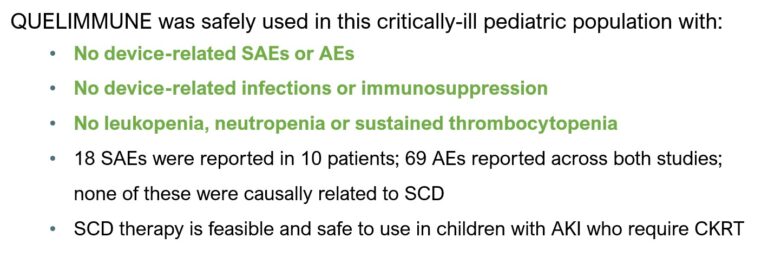
Secondary Outcomes:
QUELIMMUNE (SCD-PED) therapy demonstrated:
– 77% survival rate at Day 60
– No dialysis required in survivors (Day 60 after ICU discharge)
– 87.5% of survivors had normal kidney function (Day 60 after ICU discharge)

These data were published in the journal Kidney Medicine.
Rx Only
read more about the pediatric clinical studies here:
INDICATIONS FOR USE
CONTRAINDICATIONS
WARNINGS
- Carefully read all warnings, precautions, and instructions before use. Follow all operating, maintenance, and installation procedures as described in this document.
- The blood flow path in the SCD-PED is non-sterile.
- Operating procedures are to be performed only by trained and qualified clinicians/personnel.
- The target post-SCD ionized calcium level during SCD-PED therapy is less than 0.40 mmol/L.
- The CKRT device and disposables must be operated by trained personnel according to the instructions for use provided by the manufacturer.
- The use of anything other than the SCD Blood Tubing Set provided by SeaStar Medical may result in patient injury.
- Do not modify the SCD-PED Cartridge or the SCD Blood Tubing Set in any way.
- Carefully inspect barriers of all items prior to use. Do not use item if barrier is damaged.
- The SCD-PED Cartridge and SCD Blood Tubing Set are single use sets. Do not sterilize or reuse the SCD-PED Cartridge. Do not re-sterilize or reuse the SCD Blood Tubing Set.
- Log or note the lot number of the SCD-PED Cartridge(s) used on a patient in that patient’s Electronic Medical Record (EMR) for tracking purposes.
- During the prime and operation procedures, observe closely for blood/fluid leakage at all circuit connections. If tightening the connections does not stop leakage, immediately replace the SCD-PED Cartridge and the SCD Blood Tubing Set. Leakage can cause blood loss or air entry/air embolism.
- To prevent contamination, the SCD-PED Cartridge and the SCD Blood Tubing Set must be connected and primed using aseptic technique immediately after opening the packaging and removing caps to make the connections. Use aseptic technique when handling all connections and replacing the SCD-PED Cartridge and the SCD Blood Tubing Set. Universal precautions should be followed to ensure the safety of the patient and clinician.
- In the event that a patient decompensates (per the treating physician’s clinical judgment) within 2 hours of a new SCD-PED Cartridge initiation, SCD-PED therapy should be terminated, and a blood sample should be obtained from the patient and cultured for aerobic, anaerobic, and fungal organisms.
- Store the SCD-PED Cartridge in a dry place, between 5 °C (41 °F) and 30 °C (86 °F). The upper limit for the SCD Blood Tubing Set is 50 °C (122 °F), with no lower limit specified.
ADVERSE REACTIONS
Five adverse reactions were observed in more than one instance across the two pediatric SCD studies (SCD-PED-01 [16 subjects enrolled] and SCD-PED-02 [6 subjects enrolled]). Those adverse reactions include six instances of hypotension across three subjects, four instances of hypothermia across two subjects, four instances of tachycardia across three subjects, two instances of hyperglycemia across two subjects, and two instances of thrombocytopenia across two subjects.
